
Science
With the promise of transformational astrophysics, this will be the first telescope designed to trace our cosmic roots and fully characterize Earth-like exoplanets.
Introduction
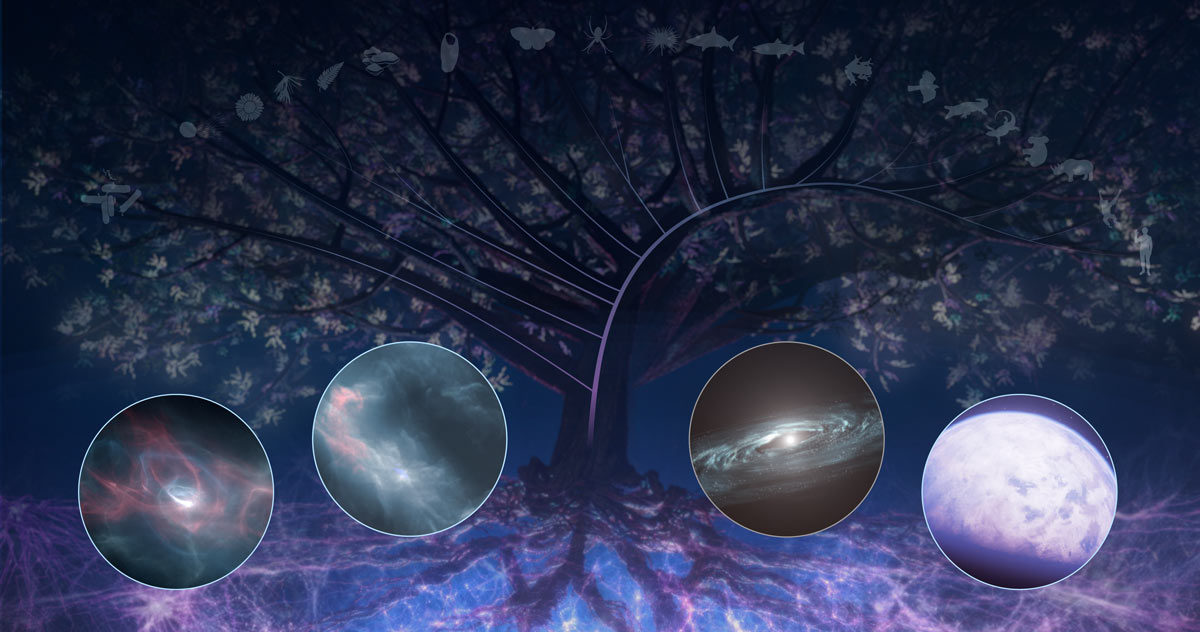
The Tree of Life Is Rooted in the Stars
The Habitable Worlds Observatory (HWO) is a large infrared, optical, and ultraviolet space telescope recommended by the National Academies’ report, "Pathways to Discovery in Astronomy and Astrophysics for the 2020s." It would be the first space telescope designed specifically to search for signs of habitability and life on planets orbiting other stars, and the processes in our universe that enable habitability. Success in the search for life would be a monumental achievement on a global scale. HWO will transform our understanding of our cosmic roots.
Science Themes
Drivers of Galaxy Growth
As galaxies from the earliest epochs gravitationally pulled in dark matter and normal matter, and merged with other galaxies, new stars formed and supermassive black holes were fed. From these processes, the elements necessary for life are created, mixed, and scattered across the cosmos.
With incredible sensitivity to ultraviolet, optical, and near-infrared wavelengths — and its capabilities to take sharp images and rapidly acquire multi-object spectra, only HWO can:
- Take sensitive imaging and spectroscopic data that can produce accurate 3D maps of energetic galactic gas flows and recycling over billions of years.
- Map the flows of heavy elements as they are mixed from many stellar sources.
- Constrain the nature of dark matter, cold or warm, from its ability to detect the faintest satellites around massive galaxies.
- Detect soon-to-merge supermassive black holes, enabling us to possibly predict the gravitational waves to come after they coalesce.
- Perform other transformational astrophysics related to cosmology and galaxies.
Evolution of Elements Over Cosmic Time
Stars create the elements and disperse them through tremendous stellar winds and violent explosions. Understanding these processes requires detailed information about the formation, distribution, and evolution of stars.
With incredible resolution — 25 times sharper than Hubble’s vision — HWO will:
- Resolve individual stars in the densest cores of star-forming regions in our galaxy.
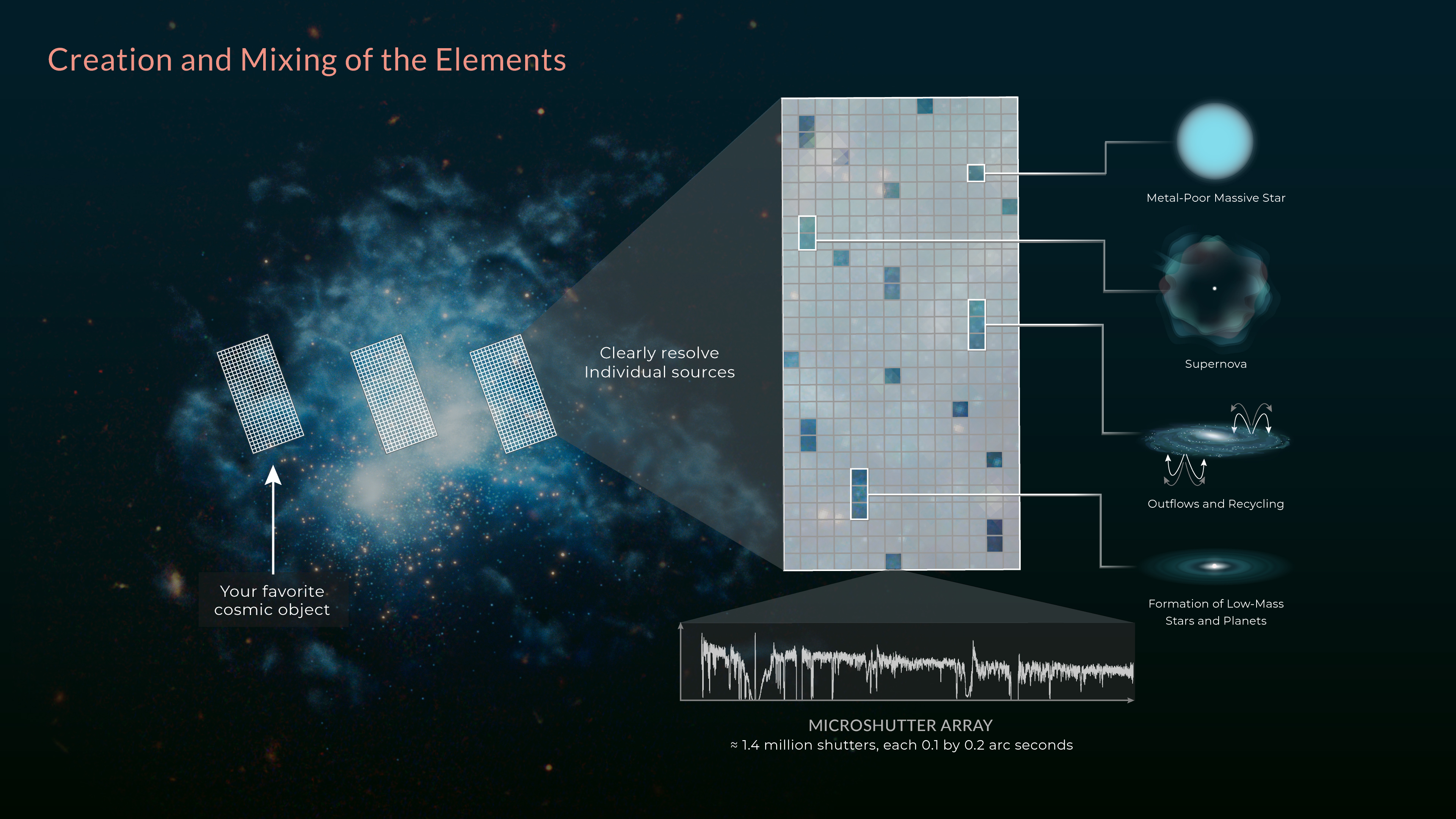
- Enable astronomers to study hundreds of stars with each observation, providing windows into the sources of the elements required for life.
- Perform spatially-resolved spectroscopy of key diagnostic lines required to identify the elements and the environments from which stars are made, thanks to its ability to observe across ultraviolet, optical, and near-infrared wavelengths.
- Probe the formation of stars and the creation of elements 1,000 times faster than Hubble.
Solar System in Its Galactic Context
Planetary systems, like our solar system, form over millions of years through dynamic processes. The initial gas-rich cloud around a forming star will carry with it the elements necessary for life created from previous generations of stars. Understanding the full range of planetary systems requires detailed observations through their various states of formation, from the T-Tauri phase to the protoplanetary disk dispersal — through the growth of giant planets, the slow removal of debris disks, and the eventual array of diverse planetary systems with potentially habitable worlds.
HWO’s large mirror, suite of instruments, and ability to observe from ultraviolet to near-infrared wavelengths will enable astronomers to study planetary systems at all scales, from our own solar system to newly forming systems embedded within their nascent clouds that were enriched by the elements formed in previous generations of stars. HWO will:
- Deliver multi-object spectroscopic data of newly forming planetary systems and their gas-rich envelopes within star-forming regions.
- Make detailed ultraviolet observations of protoplanetary disks from a next-generation Integral Field Spectrograph.
- Provide direct imaging of forming exoplanets and debris disks with the most sophisticated space-based coronagraph ever built.
- Enhance our understanding of the role giant planets and brown dwarfs play in planetary systems with direct studies of our solar system's giant planets.
- Enable solar system observations in incredible fidelity over long-baselines for long-term studies.
View the From Protoplanetary Disks to Planetary Systems Infographic
Living Worlds
Finding living worlds — not just habitable worlds but worlds that contain life — requires an understanding of planetary processes that produce biomarkers that, in certain combinations, could signify active processes from life. These biomarkers, including elemental and molecular signatures, are difficult to observe directly in exoplanet atmospheres. This effort requires the most sensitive instruments ever flown in space along with a multidisciplinary understanding of planetary processes. HWO will:
- Study a sample of nearby stars with known exoplanets that have a high probability of habitability.
- Provide key observational follow-up studies of exoplanets to deepen our understanding of their stellar environments and likelihoods for habitability.
- Enable exquisite follow-up spectroscopy of their atmospheres using the most sophisticated coronagraph ever flown in space, looking for signs of water and biomarkers for life.
- Allow follow-up observations of the best candidates, searching for signs of seasonal variability and confirming if there are Earth-like planets in the sample.
- Provide the first real census of the likelihood or presence of life in our galaxy.



Opportunities for Transformational Science
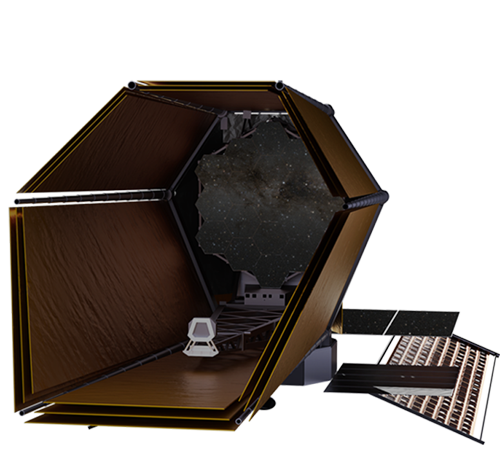 The Habitable Worlds Observatory will power breakthroughs in all areas of astrophysics by:
- Mapping deep fields eight times faster than Hubble and four times faster than the James Webb Space Telescope.
- Delivering ultraviolet spectra from 1.4 million individual shutters.
- Returning precise proper motions from sub-microarcsecond astrometry.
- Mapping the baryon cycle in emission and absorption.
- Providing reliable photometry in fields 50 times denser than Hubble.
- Searching 100 star systems for Earth-like planets.
- Seeking exoplanet biosignatures.
- Resolving the outer solar system at the same resolution as in-situ spacecraft.
- Seeing all the “building blocks” of galaxies.
- Observing 29th magnitude point sources in an hour.
- Being designed for servicing to achieve leaps in instrument capabilities.
- Your idea here!
We invite you to explore how this observatory will enable new science in areas of astrophysics that interest you most.