
Contributors
Guiding the early maturation of the Habitable Worlds Observatory.
On This Page
Investing Early for Flagship Success and National Leadership
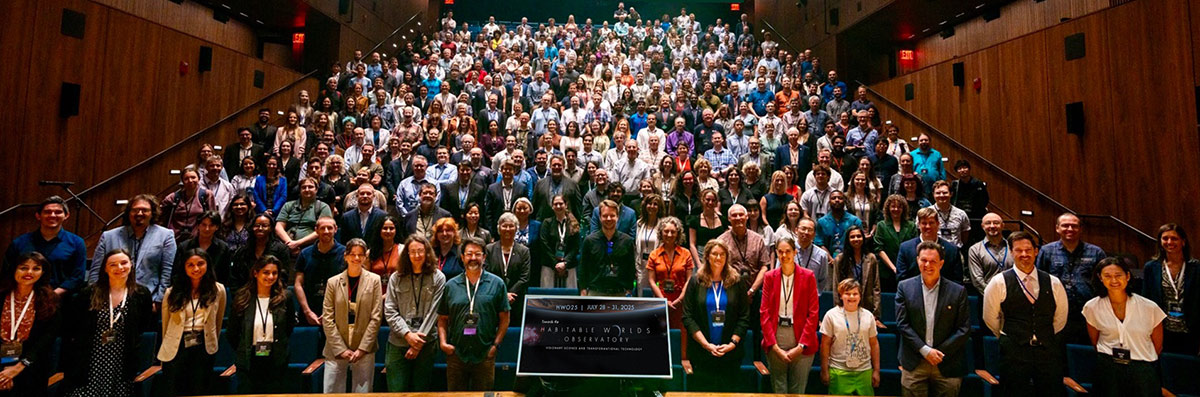
Building on the technological foundations established by past flagship astrophysics missions, in particular the James Webb Space Telescope and the Nancy Grace Roman Space Telescope, NASA’s Great Observatory Maturation Program will unite government, industry, and academia to develop technologies needed for Habitable Worlds Observatory, NASA’s next flagship astrophysics mission. This program aims to advance and combine the segmented mirror and coronagraph technologies developed for prior flagship space telescope missions and design an observatory that is serviceable through its full mission life.
Drawing on lessons learned from previous NASA missions, the program will help NASA streamline development of the Habitable Worlds Observatory concept and decrease budget and schedule risks for a future mission. Following Roman, the Habitable Worlds Observatory would be a result of national cooperation drawing on the knowledge gained through work on previous large NASA observatories.

Paving the future development path for Habitable Worlds Observatory requires early investment in key technologies to prevent costly redesigns. Capturing the highly skilled workforce — at NASA and in industry and academia — created for Webb and Roman is also critical for future success. Early investments in both technology and knowledge would help make future flagship missions like the Habitable Worlds Observatory a scientific, technical, and programmatic success while maintaining the global leadership of the United States in space science.
NASA Project Office
On August 1, 2024, a major milestone was reached that has already begun to accelerate the Habitable Worlds Observatory’s concept development. An official project office for the mission, the Habitable Worlds Observatory Technology Maturation Project Office (TMPO), pronounced “tempo,” opened at NASA Goddard Space Flight Center. TMPO assumes the responsibilities of the observatory’s Community Science and Instrument Team (CSIT) and Science Interest Groups. TMPO will lead development and refinement of the telescope’s science objectives and architectures. HTMPO developed a pre-formulation plan that includes organizational management structure and a Technology Maturation Roadmap. It will continue international contribution discussions in coordination with NASA Headquarters, engage with industry, invest in longer term acquisition planning, and follow NASA inclusion and mentoring guidelines. A key goal of the pre-formulation plan is to get to a successful mission concept review as soon as possible and enter Phase A.
Project Office Leadership
-
Lee Feinberg, NASA Goddard Space Flight Center, Principal Architect
Scott Smith, NASA Goddard Space Flight Center, Project Manager (interim)
Michael Menzel, NASA Goddard Space Flight Center, Mission Systems Engineer
Giada Arney, NASA Goddard Space Flight Center, Project Scientist (interim)
John Ziemer, NASA JPL, Pre-Formulation Architect, (JPL ex-officio)
Aki Roberge, NASA Goddard Space Flight Center, Pre-Formulation Scientist (interim)
Bertrand Mennesson, NASA JPL, Pre-Formulation Scientist, (JPL ex-officio) -
Breann Sitarski, NASA Goddard Space Flight Center, Deputy Principal Architect
Alice Liu, NASA Goddard Space Flight Center, Deputy Mission Systems Engineer
Matthew Bolcar, NASA Goddard Space Flight Center, Chief Technologist
Feng Zhao, NASA JPL, Deputy Chief Technologist, (JPL ex-officio)
Julie Van Campen, NASA Goddard Space Flight Center, Servicing and Instrument Systems Lead
Marie Levine, NASA JPL, Integrated Modeling Lead, (JPL ex-officio)
Early Community Planning for the Habitable Worlds Observatory
NASA established the Community Science and Instrument Team (CSIT) to bring the expertise of the scientific community directly into the early stages of planning for the Habitable Worlds Observatory (HWO). CSIT selections were announced in June 2025.
The CSIT will serve as key liaisons to the broader scientific community, fostering communication and ensuring wide input into the mission's development, lead scientific investigations to help the project establish the observatory's primary science objectives and requirements, analyze TMPO-provided science instrument concepts and support basic instrument definition, and provide valuable scientific perspectives on the technology development plans that will enable the telescope to achieve its goals.
CSIT Member Listing
-
David Charbonneau, Harvard University, Co-Chair
Evgenya Shkolnik, Arizona State University, Co-Chair
Michael Bottom, University of Hawaii
Eric Burns, Louisiana State University
Richard Cartwright, Johns Hopkins Applied Physics Laboratory
Ewan Douglas, University of Arizona
Kevin France, University of Colorado Boulder’s Laboratory for Atmospheric and Space Physics
Scott Gaudi, Ohio State University
Rebecca Jensen-Clem, UC Santa Cruz
Janice Lee, Space Telescope Science Institute
Victoria Meadows, University of Washington
Chris Packham, University of Texas at San Antonio
Laurent Pueyo, Space Telescope Science Institute
Tyler Robinson, University of Arizona
Jason Tumlinson, Space Telescope Science InstituteHWO Program Coordination Contacts
Ex-officio members serve as points of contact for coordinating science activities and conveying the broad scientific perspectives of their space agencies and regional communities.Anthony Boccaletti (ex-officio), European HWO Program Coordination Group
Jean Dupuis (ex-officio), Canadian Space Agency
Paul McNamara (ex-officio), European Space Agency
Takahiro Sumi (ex-officio), Japan Aerospace Exploration Agency
HWO Science Interest Group (SIG)
The Habitable Worlds Observatory (HWO) Science Interest Group (SIG) is a community-led effort that combines many of the NASA Program Analysis Groups (PAGS) into an interdisciplinary forum aimed at fostering communications within the science community and with NASA about the science HWO will enable.
Science Interest Group
-
Cosmic Origins
Joe Burchett, New Mexico State University
Vivian U, IPAC at CaltechExoplanet Exploration
Jessie Christiansen, IPAC at Caltech and NExScI (NASA Exoplanet Science Institute)
Laura Mayorga, Johns Hopkins Applied Physics LaboratoryPhysics of the Cosmos
Richard Massey, Durham University
Fabio Pacucci, Center for Astrophysics | Harvard & Smithsonian
Working Groups
Science and Technology Working Groups, which advanced the mission concept, were active within the Habitable Worlds Observatory Technology Maturation Project Office from September 2023 to July 2025. The four Science Working Groups prepared about 70 science case development documents that were released in May 2025 for public comment and endorsement.
Science Working Groups Membership
-
Living Worlds
Giada Arney, NASA Goddard Space Flight Center
Niki Parenteau, NASA AmesEvolution of the Elements
Janice Lee, Space Telescope Science Institute
Paul Scowen, NASA Goddard Space Flight CenterGalaxy Growth
Swara Ravindranath, NASA's Cosmic Origins Program Office
Marc Postman, Space Telescope Science InstituteSolar Systems in Context
Tyler Robinson, University of Arizona
Evgenya Shkolnik, Arizona State University -
Science Case Simulation
Natasha Batalha, NASA Ames
Rachel Osten, Space Telescope Science InstituteScience Data Simulation
Tom Greene, NASA Ames
Jason Tumlinson, Space Telescope Science InstituteScience-Engineering Interface
Patrick Morrissey, NASA JPL
Breann Sitarski, NASA Goddard Space Flight CenterArtificial Intelligence and Machine Learning
Megan Ansdell, NASA Headquarters
Bruce Dean, NASA Goddard Space Flight CenterGround-Based Astronomy in the 2030s/2040s
Satoshi Miyazaki, JAXA (Japan Aerospace Exploration Agency) and the National Astronomical Observatory of Japan
Mercedes López-Morales, Space Telescope Science InstituteSpace-Based Astronomy in the 2030s/2040s
Robert Petre, NASA Goddard Space Flight Center
Tiffany Kataria, NASA JPL
Emma Louden, Yale UniversitySynergies for Future Missions
Jessica Gaskin, NASA Marshall Space Flight Center
Jim Oschmann, Marinus ConsultingServicing
John Grunsfield, NASA
Julie Van Campen, NASA Goddard Space Flight CenterHigh-Contrast Post-Processing and Concept of Operations
Dimitri Mawet, NASA JPL
Mike McElwain, NASA Goddard Space Flight CenterCommunications
Travis Schirner, NASA JPL
Amber Straughn, NASA Goddard Space Flight CenterDEIA & Mentorship
Rachael Beaton, Space Telescope Science Institute
Evan Scannapieco, Arizona State UniversityPast Studies Comparison
Scott Gaudi, Ohio State University
-
Systems
Michael Menzel, NASA Goddard Space Flight Center
Stuart Shaklan, NASA JPLIntegrated Modeling
Marie Levine, NASA JPL
Alice Liu, NASA Goddard Space Flight CenterTechnology
Matthew Bolcar, NASA Goddard Space Flight Center
Feng Zhao, NASA JPLServicing
Julie Van Campen, NASA Goddard Space Flight Center
John Grunsfeld, NASA
Guiding Committees
In September 2023, NASA selected 56 individuals to participate in the Science, Technology, Architecture Review Team (START) and Technical Assessment Group (TAG). In August 2024, the Habitable Worlds Observatory Technology Maturation Project Office (TMPO) was formed and assumed the responsibilities of the START and TAG.
START Membership
-
Courtney Dressing, University of California, Berkeley
John O’Meara, W. M. Keck Observatory -
Giada Arney, NASA Goddard Space Flight Center
Natasha Batalha, NASA Ames
Eric Burns, Louisiana State University
Jessie Christiansen, NASA Exoplanet Science Institute
Kevin France, University of Colorado Boulder
Scott Gaudi, Ohio State University
Renyu Hu, NASA JPL
Alina Kiessling, NASA JPL
Janice Lee, Space Telescope Science Institute
Bruce Macintosh, University of California Observatories
Jim Oschmann, retiree
Rachel Osten, Space Telescope Science Institute
Chris Packham, University of Texas at San Antonio
Lynnae Quick, NASA Goddard Space Flight Center
Jason Rhodes, NASA JPL
Jane Rigby, NASA Goddard Space Flight Center
Ty Robinson, University of Arizona
Dmitry Savransky, Cornell University
Evan Scannapieco, Arizona State University
Evgenya Shkolnik, Arizona State University -
Industry
Charlie Atkinson, Northrop Grumman
Matthew East, L3Harris
Alison Nordt, Lockheed Martin
Erik Wilkinson, BAE Systems, Inc.NASA Program Offices
Eric Mamajek, NASA Exoplanet Exploration Program
Swara Ravindranath, NASA's Cosmic Origins Program OfficeInternational
Satoshi Miyazaki, JAXA (Japan Aerospace Exploration Agency) and the National Astronomical Observatory of Japan
Takahiro Sumi, JAXA, (Japan Aerospace Exploration Agency), Osaka
Ana Gomez de Castro, ESA (European Space Agency), Madrid, Spain
Michiel Min, ESA (European Space Agency) and SRON (Space Research Organization Netherlands)
David Mouillet, ESA (European Space Agency), Grenoble, France
Christian Marois, Canadian Space Agency (CSA) and the National Research Council of Canada (NRC) -
Lee Feinberg, NASA Goddard Space Flight Center
Bertrand Mennesson, NASA JPL
Aki Roberge, NASA Goddard Space Flight Center
John Ziemer, NASA JPL -
Ruslan Belikov, NASA Ames
Matthew Bolcar, NASA Goddard Space Flight Center
Jason Derleth, NASA's Cosmic Origins Program Office (ex-officio)
Kevin Fogarty, NASA Ames
Jessica Gaskin, NASA Marshall Space Flight Center
Thomas Greene, NASA Ames
Brian Kern, NASA JPL
Marie Levine, NASA JPL
Alice Liu, NASA Goddard Space Flight Center
Sangeeta Malhotra, NASA Goddard Space Flight Center
Dimitri Mawet, NASA JPL
Michael McElwain, NASA Goddard Space Flight Center
Michael Menzel, NASA Goddard Space Flight Center
Patrick Morrissey, NASA JPL
Niki Parenteau, NASA Ames
David Redding, NASA JPL
Stuart Shaklan, NASA JPL
Nick Siegler, NASA Exoplanet Exploration Program (ex-officio)
Breann Sitarski, NASA Goddard Space Flight Center
Philip Stahl, NASA Marshall Space Flight Center
Christopher Stark, NASA Goddard Space Flight Center
Julie Van Campen, NASA Goddard Space Flight Center
Feng Zhao, NASA JPL